Related

Resource
The Youth Access Quality Framework

Publication

This briefing on Early Support Hubs in focus aims to capture key information in one place about why they exist, who they work for, how they function, what challenges they face and how to maximise their impact.
Young people today face significant barriers to getting help as they transition into adulthood.
Historic increases in the cost of living and the aftermath of a global pandemic have created difficult terrain on the journey to adulthood. Entrenched inequalities also mean that for some the climb is even steeper. At the same time, long waiting lists for mental health support and cuts to youth services have left young people alone and unable to find their footing. Young people tell us that they want easy to access wrap-around support in their local community that equips them along the way.
There is growing recognition of the effectiveness of Early Support Hubs - providing integrated youth advice, mental health, and wellbeing support in local communities. The Fund the Hubs Campaign has campaigned for the national roll out of Early Support Hubs since 2020.
This briefing on Early Support Hubs in Focus aims to capture key information in one place about why they exist, who they work for, how they function, what challenges they face and how to maximise their impact.
Early Support Hubs - also known as youth advice and counselling services (YIACS), youth mental health hubs, or one-stop-shops - offer flexible, community-based advice and mental health support to children and young people typically between 11-25 years old, on a self-referral basis. Many deliver to the Youth Access model of support.
Watch this video to see and hear from Early Support Hubs and young people about what defines this support.
Early Support Hubs help young people in local communities, typically from age 11 to 25, including those less likely to engage with statutory services. Research shows Early Support Hubs are particularly effective at engaging:
Young people who come to Early Support Hubs often face multiple, overlapping challenges rather than a single issue.
Mental health: The most common mental health presentations are anxiety and depression. Some young people also disclose self-harm, suicidal thoughts, eating difficulties and experiences of trauma or exploitation.
Practical advice and support needs: including housing insecurity, debt, family and relationship difficulties (including domestic violence), and employment challenges.
Wider health needs: including harmful drug and alcohol use and sexual health needs.
Other overlapping needs: such as support for neurodiversity, difficulties in school or work, and a sense of belonging around queer or gender-diverse identities. Involvement in crime is rarely the reason for initial attendance, but trusting relationships built over time allow disclosures of risk-taking or offending behaviour, which practitioners can then respond to appropriately.
The high level of overlapping needs that young people present with reflects the accessibility and trust associated with Early Support Hubs. Early Support Hubs are often a vital form of provision for children and young people who have not felt able to engage with alternative support pathways, thereby addressing unmet need. [See below case study: effective support for young people with interconnected needs].
Centre 33’s Someone to Talk To Service provides a safe, inclusive space for young people aged 13-25 to access confidential, one-to-one support and access pathways into further interventions such as counselling across both rural and urban areas.
It also plays a vital role in reaching young people who are often marginalised and addressing intersecting challenges. Nearly half of the young people they support present with eight or more interconnected needs, highlighting the complexity of their situations.
Centre 33 also has better reach to young people typically underserved than statutory services. 84% of young people attending their drop-in belong to one or more groups typically underserved, compared with 64% in statutory services including young people living with a disability (47%) and unemployed, under employed or not in education (23%).
Support is effective too. At the point of access, 66% of young people present with moderately severe or severe psychological distress (as measured using CORE/CORE-10).
After engagement:
Josh*, a 24-year-old care leaver, was referred to the Isle of Wight Youth Trust by the Department for Work and Pensions Work Coach. He had experienced frequent homelessness, and time in prison, making housing and employment extremely challenging. He was rough sleeping, without a phone, and struggling to meet his basic needs while relying on Universal Credit.
Over 9 days, the Isle of Wight Youth Trust provided Josh with a safe, warm space, phone charging, and one-to-one support from all staff. The team coordinated with his Universal Credit Work Coach to secure a phone and liaised with debt management to pause payments.
Tailored housing support was provided by Isle of Wight Youth Trust, helping Josh present his case to the council for Priority Need consideration, leading to emergency B&B accommodation. The service also worked closely with the Leaving Care and Home Treatment Teams and funded a gym membership so Josh could access showers.
For employment, the team helped Josh strengthen his CV and explore opportunities, particularly live-in roles. With this support, he successfully interviewed for and secured a live-in Sous Chef position in a new area and prepared to relocate the following week. Josh was given a comprehensive guide to services in his new area to ensure continued support if he needed it.
*Josh's name has been changed.
Extending support beyond 18 helps prevent the “cliff edge” in services when young people transition to adulthood. Offering support up to age 25 supports young people:
Early intervention is critical: three-quarters of adults with diagnosable mental health conditions experience first symptoms before age 25.
Emerging research in Transitional Safeguarding recognises that adolescence and the transition into adulthood involves a whole host of changes within young people’s lives, making this a particularly challenging and vulnerable time. Despite this the divergence between safeguarding systems for children (which typically end at age 18) and adults safeguarding creates gaps through which adolescents and young adults may fall.
By providing support up to age 25, Early Support Hubs acknowledge that developmental needs do not suddenly disappear at 18. Instead, they help young people manage this transitional period safely.
“Access to a hub has made me who I am. A hub is somewhere you don’t feel like a statistic and somewhere you can rely on – whether this be mental health support, support with accessing work, college or university.” - A young person at the Young Person’s Advisory Service, Liverpool
“You go back home and you’re like wow I’ve just had that relief. I feel a completely different person now to who I was walking in – it's the trust in other people that means a lot.” - A young person at 42nd Street, Manchester
“They can relate to where I have come from. This place has helped me a lot. Without No Limits I would have been struggling and homeless. We need more places like this. The staff are very welcoming and supporting, and they understand too.” - A young person at No Limits, Southampton
Early Support Hubs offer easy-to-access, drop-in support addressing mental health and wider wellbeing and practical support and advice needs. Early Support Hubs offer support that responds to the ‘whole person’ not just isolated challenges or symptoms.
Services typically include:
Wider services may also be provided to adapt to local need and respond to young people’s feedback. This may include
Sammy*, an 18-year-old care leaver, began working with the Isle of Wight Youth Trust through accessing mental health support. She worked through 12 therapeutic sessions to address past trauma and help her build confidence and prepare for her next steps.
Following this, the team worked with her to identify priorities and develop a tailored support plan. Her first priority was housing, as she was uncomfortable in supported accommodation due to other residents’ drug use and was spending the majority of her time rotating around a number of friend homes. The service supported Sammy in registering with the local housing provider and coordinated with her supported accommodation provider to create a Pathway to Independence plan to support her transition to independent living.
With greater stability in her housing, Sammy then wanted to focus on employment. The Hub provided one-to-one support with CV writing, job searching, and networking. Within four weeks, she secured three job offers, accepting two part-time roles. The service also worked with DWP to provide funding for work clothing and travel, ensuring she could start work smoothly.
The Isle of Wight Youth Trust further supported Sammy’s social and career development goals, helping her access group activities and build relationships and secure a bursary for driving lessons to expand future career opportunities. She has now completed her Pathway to Independence steps with her supported accommodation provider, who is assisting her to find affordable independent housing. Sammy continues to stay in touch and uses drop-in services to maintain progress toward her goals.
*Sammy's name has been changed.
Many Early Support Hubs deliver to the Youth Access model. The Youth Access model describes local services supporting young people with the following service characteristics:
The Youth Access model is also guided by the below principles:
No Limits offers free information, advice and help to children and young people under the age of 26 in Hampshire, the Isle of Wight, Portsmouth and Southampton. The Advice Centre is central to No Limits’ open access offer. It provides information, advice and practical support to young people on any issue they present with. It also hosts partner agencies, such as a sexual health clinic, enabling young people to access multiple services in one safe and welcoming environment. In addition to face-to-face support, youth workers provide telephone and online chat services and manage the organisation’s single point of access, triaging referrals into appropriate services.
The open access model is particularly beneficial for young people who may only require short-term support, feel unable to engage with more formal services, or have complex or unstable circumstances that make attending scheduled appointments challenging. By providing a flexible and accessible entry point, the Advice Centre helps to build trust and familiarity, reducing barriers to engaging in longer-term or specialist support where needed.
The Advice Centre is located in a central and easily accessible area of Southampton and operates for over 40 hours per week, including evenings and weekends, to maximise accessibility. Alongside its open access provision, No Limits delivers a range of specialist and targeted services accessed via referral, including self-referral. These include a drug and alcohol service, community counselling, therapeutic groups, an out-of-hours safe haven, youth groups, an LGBT service, a young parents project, a work club, tenancy support, and additional tailored programmes designed to meet emerging needs.
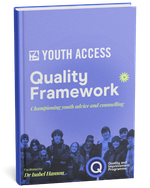
The Youth Access Quality Framework sets out what good looks like for hubs, providing a clear, shared structure for defining and demonstrating quality. It aims to help local services show their impact, drive continuous improvement and guide investment decisions.
The Quality Framework comprises 18 areas of quality, organised into three categories:
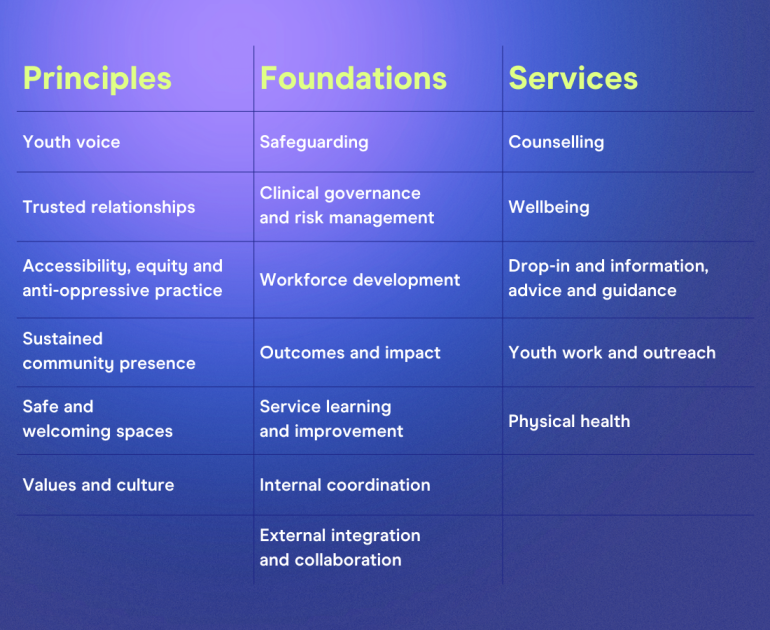
View the Youth Access Quality Framework in full to understand more about how the principles, foundations and services operate in high quality Hubs in practice.
In 2026, Youth Access will launch an interactive Digital Tool to help hubs assess their quality across all 18 areas of focus. The tool will include Gold, Silver, Bronze, and Developing levels to support reflection, evidence gathering, and continuous improvement. Alongside this, Youth Access is developing a range of learning and development resources aligned to the Quality Framework to help services strengthen their provision for young people.
Early Support Hubs provide psychosocial support in a welcoming, non-clinical environment, focused on early intervention, accessibility, and strengths-based support that responds to young people’s needs. They operate within clinically robust governance frameworks to ensure safety and accountability.
A psychosocial model of support focuses on addressing wider psychological, social and environmental factors that impact on a person’s mental health. This is different to a medical model which focuses on working with symptoms and treatment for individuals, including medication. Many people benefit from a combination of both.
In practice, Early Support Hubs:
This blended approach ensures hubs remain welcoming and youth-centred while maintaining safe, coordinated care across varying levels of need.
In medicine, clinical refers to the examination, diagnosis and treatment of illness. In the context of Early Support Hubs, the term clinical can refer to different elements and should be clearly explained when used.
For example:
No. Early Support Hubs feel welcoming, safe, and youth-friendly rather than institutional or hospital-like. A non-clinical environment helps reduce anxiety and stigma while encouraging engagement.
Yes, and.
Yes: Early Support Hubs offer structured therapeutic support delivered by trained and registered professionals such as counsellors and psychotherapists in line with defined standards of governance and clinical practice.
Some Early Support Hubs are commissioned by Integrated Care Boards to deliver community talking therapies, follow clinical practice guidelines, collective clinical routine outcome measures and report to the NHS Mental Health Services Data Set.
However, Early Support Hubs are not primarily driven by a medical treatment model and do not diagnose or prescribe medication.
And: Early Support Hubs also offer non-clinical approaches including youth-centred support provided by staff such as youth workers, advice workers, peer support workers and wellbeing practitioners. Offering clinical and non-clinical approaches in combination supports the delivery of the psychosocial model of support which aims to reduce barriers to help-seeking by tailoring responses to the whole-life needs of young people.
Because open-access services may see young people in acute distress or at risk, clinical and non-clinical staff must respond safely and follow clear escalation pathways – see: Do Early Support Hubs have clinical governance?
Yes: Some clinical staff, but not all clinical staff.
Some support in Early Support Hubs is delivered by a clinical workforce by which we mean qualified and registered practitioners such as counsellors, psychotherapists, family therapists, creative or arts therapists and young people’s wellbeing practitioners including CYPWPs and EMHPs).
Early Support Hubs do not typically provide in-house roles responsible for diagnosis or prescribing but can co-locate with NHS services that do. For example No Limits Advice Centre offers weekly sexual health clinics staffed by a specialist NHS sexual health nurse.
GPs, psychiatrists, and other specialist clinicians are usually engaged through partnership arrangements and multidisciplinary meetings, rather than being directly employed within the Early Support Hub itself. This can include:
A linked primary care model can strengthen integration. For example, the Young Person’s Advisory Service (YPAS) model in Liverpool includes:
This approach supports shared governance and appropriate clinical escalation without requiring permanent GP presence or disrupting the continuity of care with the young person’s registered GP.
Yes. Strong clinical governance is essential because open-access services may encounter high-risk presentations, including self-harm, suicidality, acute distress, physical illness, or risks to others.
Early Support Hubs require two complementary forms of safeguarding:
Both are essential: without acute protocols hubs are unsafe, but without trusted relationships and sustained relational work young people will not attend or disclose risk.
Good practice hubs:
Youth voice is central to effective Early Support Hub provision where young people influence, shape and lead services in meaningful ways. Early Support Hubs uphold and advocate for young people’s individual and collective rights, empower them to make informed decisions, and support their participation in matters that affect their lives both within the organisation and across wider services.
Youth voice may include both internal and external opportunities: decision-making within the organisation (e.g. service design or governance), delivering provision through peer support and lived experience roles, and wider social action (e.g. campaigns, advocacy, or research).
See the Youth Access Quality Framework: Youth voice for more information on high quality youth voice in practice.
Yes. Early Support Hubs provide some form of digital provision. This might look like webchats for young people to talk about mental health without needing an appointment, online workshops and group sessions, digital self-help resources on topics from exam stress to a guide to budgeting or one to one video counselling sessions.
Digital provision is designed to complement, not replace, the available face-to-face support in Early Support Hubs, giving young people multiple ways to access support and reducing barriers to engagement. Establishing trusted relationships is a core area of focus for Early Support Hubs and digital mental health provision is developed with careful attention to how the therapeutic relationship can be fostered and maintained in an online environment, given its central role as a predictor of positive outcomes.
42nd Street, an Early Support Hub in Manchester, has developed Breathe, a co-managed digital mental health support platform for children and young people aged 13-25 living in Greater Manchester who can self-refer and receive confidential support. Every aspect of Breathe, from platform design to content, has been youth-led ensuring it meets the needs of young people.
Originally launched as a text-based service, the platform has since evolved to offer a range of online support options, including: asynchronous text-based support, where messages are sent and received at different times (e.g. weekly messaging); synchronous (real-time) text chat; online drop-in sessions; group-based sessions, which may be text- or video-based (via Microsoft Teams); and individual video-based support (also via Microsoft Teams).
A defining feature of this service is that users are not anonymised. This deliberate design choice facilitates robust safeguarding procedures while maintaining the ethos of trust and collaboration central to 42nd Street’s approach.
Each young person is paired with a designated staff member, such as a person-centred or integrative counsellor, cognitive behavioural therapist, or psychosocial worker, to work collaboratively on issues contributing to psychological distress. Young people are also encouraged to access additional forms of support, such as peer support groups, online drop-in sessions, or creative groups, depending on their preferences and needs. An evaluation of the programme found 95% satisfaction rates.
Early Support Hubs are primarily places for help and support by a multidisciplinary workforce whereas youth clubs are typically places for young people to meet with a focus on positive activities.
Early Support Hubs are young person-centred and primarily designed to support young people – they are the main focus, purpose and audience of these services. Families are not the primary clients.
However, family involvement may occur in the following circumstances:
The key theme is that any family support offered is secondary and revolves around supporting the young person, rather than serving parents or carers as the main focus.
The Fund the Hubs campaign estimates that there are currently over 70 Early Support Hubs but they are not yet universally available in every community. Many have operated for decades, growing out of a ‘bottom up’ process of development, emerging to respond to young people’s needs. For example:
There are high levels of variation in the shape and sizes of Early Support Hubs due to differences in levels of need, the wider local ecosystem of provision, and available sources of local and national funding. For example, the smallest Early Support Hubs support a few hundred young people per year, and the largest support over 14,000 young people annually.
Research has identified the significant gaps in the availability of non-specialist mental health services across England with no clear relationship with local demographics, levels of deprivation or specific indicators of mental healthcare need, such as waiting times for NHS services or hospital admissions for mental health reasons.
Funding for Early Support Hubs is diverse in England. They typically piece together funding from local authorities, Integrated Care Boards, national government departments, Trusts and Foundations, and community and corporate fundraising.
The reality is that funding for Early Support Hubs is often short-term, fragmented, and constantly changing, making it difficult to sustain practice and plan for the medium term. Many services must “patchwork” small amounts of funding from multiple sources to keep a coherent service running.
a. Some Early Support Hubs receive funding from local authorities and Integrated Care Systems to deliver:
b. Some Early Support Hubs receive funding from national government departments for example:
In 2024/2025 the Department for Health and Social Care provided £8 million funding for 24 Early Support Hubs to expand their provision alongside an external evaluation. This was extended for two further years (£7m for 25/26 and £7m for 26/27).
Funding went to existing services to provide open-access mental health support and advice in local communities for young people up to the age of 25. It enabled services to establish new provision or expand services in underserved and high-deprivation areas.
Youth Employment Hubs, also known as ‘Youth Hubs’ are for young people aged 16-24 who are not in education, employment or training or require additional support. They are run by the DWP and often in partnership with local authorities and charities with the aim of helping young people find, stay in and progress in work. There are currently around 150 Youth Hubs in the UK, with a commitment from the Government to increase this to 360 (See: Policy background).
Early Support Hubs such as the Isle of Wight Youth Trust, in the Isle of Wight, and Chilypep in Barnsley are funded by the Department for Work and Pensions to host the Youth Hub – rather than in the local Job Centre. These partnerships mean that where a young person identifies that their mental health or wider practical needs are a barrier to being able to work – they can be supported there and then by the Early Support Hub team who combine practical employment and skills support with mental health support and advice provision.
Some Mental Health Support Team provision is delivered by, or in partnership with the local Early Support Hub. For example Off the Record Croydon and Croydon Drop In work in partnership to deliver Mental Health Support Team provision in schools across Croydon.
Connecting Mental Health Support Team provision and Early Support Hub provision ensures accessible and inclusive support is available both in and outside of schools, giving young people choice and flexibility in where to receive help.
Some Early Support Hubs successfully applied to the Youth Investment Fund to receive a grant for capital costs. For example, No Limits in Southampton used the grant to create a new open-access drop in space and improve accessibility for counselling rooms.
c. Some Early Support Hubs receive funding from Trusts and Foundations, for example:
The People’s Health Trust has funded a pioneering programme for young people that embeds Independent Placement Support worker roles within three Early Support Hubs – increasing access to specialist employment support and creating new pathways into good work. Early indications suggest this approach could create new, cost-effective pathways into work that support recovery from mental ill health.
The Prudence Trust has funded 5 Early Support Hubs since 2024 to develop understanding of what makes a good hub model, support more evidence on impact and help to make clear the value of hubs so the model can be more widely and consistently scaled up and funded. Further funding has supported 5 Hubs to build their learning and evaluation capacity or digital support.
d. Some Early Support Hubs also generate income through community fundraising
The Young Person’s Advisory Service (YPAS) provides mental health and wellbeing support to children and young people in Liverpool. The Early Support Hub funding enabled them to deliver their Branching Out Project, which allowed for wider delivery of their established youth advice and counselling services in Liverpool to two additional areas of the Cheshire and Merseyside ICB footprint (Sefton and Knowsley) for 11-25 year olds. Branching Out offers open access drop-ins, therapeutic interventions, wellbeing support, and targeted group work, enabling young people to access mental health support without stigma or delay.
Summary impact of the Department of Health and Social Care Early Support Hub funding:
Before the funding, young people in these areas did not have access to YPAS locally, with no comparable alternatives. They previously relied on long statutory waiting lists (NHS mental health assessments: 18+ weeks; treatment: 20+ weeks) or A&E/crisis pathways.
Centre for Mental Health has collected bottom-up spending data from a sample of existing Early Support Hubs, generating overall figures for estimated annual running costs of an average hub of between £1.1-£1.4 million. These 2025 costings require uprating to match inflation. Hubs should be jointly funded by government departments to cover staff and administrative costs, delivery and essential ongoing building costs such as rent.
Capital costs for the set-up of new hubs in local authority areas currently underserved could reach between £890,000 and £1.46 million per hub. Presuming that around 70 existing hubs are still operational, the set-up costs of national roll-out would be between £74 million and £121 million (based on 153 local authorities excluding district councils). Some set-up costs could perhaps be offset if existing facilities or organisations could be adapted or scaled up into Early Support Hubs.
The Fund the Hubs and Future Mind’s campaigns therefore estimate an annual total of approximately £169 million to £210 million is required for running costs for 153 Hubs with an additional £74 million - £121 million required for one-off capital costs.
Sustained funding is essential for maintaining continuity of care, effective support pathways and strong community recognition. Longevity and consistency are particularly important for young people facing complex challenges and in areas where trust in institutions is low.
When services appear and disappear, young people lose trust and continuity of care, making it harder to get help when they need it most. Long-term investment is also key from a systems perspective – by keeping support pathways effective, preventing gaps in provision.
Early Support Hubs need funding for direct service delivery and core costs. This includes clinical supervision for a healthy and supported workforce, adequate governance structures that includes meaningful youth voice, monitoring of outcomes and impact, workforce development and external partnership development.
The economic and social costs of mental health difficulties are substantial. The Centre for Mental Health estimates that mental disorders in England cost approximately £300 billion annually, encompassing economic costs (losses to the economy due to reduced productivity), human costs (the value of reduced quality of life), and health and care costs (provision of services).
Experiencing mental health difficulties during childhood or adolescence can have profound, long-term consequences. The Resolution Foundation shows that untreated youth mental health problems are associated with lower educational attainment, reduced employment opportunities, decreased lifetime earnings, economic inactivity, and increased engagement in risk-taking behaviours. Future Minds highlights that poor mental health among children and young people contributes to £1 trillion in lifetime earnings lost, with £295 million spent annually addressing deteriorating mental health while waiting for support.
Providing early and adequate mental health support for children and young people can avoid later physical and mental health challenges the life course, relieving pressure on public services and providing significant savings to wider public services and benefits to the economy.
Community-based interventions, such as Early Support Hubs, are a highly cost-effective approach. Research demonstrates that preventive and early intervention strategies can be up to 100 times more cost-effective than inpatient or crisis care. By integrating mental health support with advice and employment guidance, Early Support Hubs represent a strategic investment in both public health and economic productivity. Evidence consistently indicates that early, locally delivered support not only improves outcomes for young people but also generates savings across the life course [See case study: social return on investment analysis demonstrates clear value for money].
42nd Street is a Manchester-based mental health charity providing confidential and free support to young people aged 12–25 experiencing difficulties with their mental health and emotional wellbeing. Through the Making Manchester Fairer Young People’s Kickstarter Project (November 2023 - September 2025), the organisation aimed to reduce mental health inequalities among young people at increased risk due to social circumstances and lived experiences. The project delivered direct mental health and wellbeing support to young people, alongside bespoke training for approximately 245 community practitioners across the city.
By end of July 2025, of the 287 young people who received direct support from 42nd Street 45.3% experienced Clinical Recovery or Clinically Significant Improvement in their CORE outcomes, meaning 130 young people were most likely to have experienced at least a one-point improvement in life satisfaction. The model further considered indirect beneficiaries who were supported by the trained practitioners, and Lived Experience Young Training Practitioners who delivered the training.
A Social Return on Investment (SROI) analysis demonstrated strong value for money. Using financial proxies from HM Treasury Green Book guidance and the Greater Manchester Combined Authority Cost Benefit Analysis tool, and applying adjustments for deadweight, attribution and drop-off, the project generated a total present value of £41,330,522 over three years from an investment of £739,016 and a social value return of 55.93:1. Even under pessimistic assumptions, the return remained above 30:1, demonstrating a highly resilient and credible model delivering substantial social and economic impact.
The workforce for Early Support Hubs varies depending on the services offered and is multidisciplinary in make-up. The type of roles that you would expect to see in an early support hub include:
Staff work together closely and collaboratively to meet the diverse needs of young people. A blended team, with a shared understanding of roles, responsibilities and approaches is fundamental to delivering effective holistic support. Early Support Hubs go beyond a simple collection of co-located services or referral pathways – instead functioning as integrated teams providing seamless support.
Minimum safe operating standards require two trained staff on duty, with safeguarding and mental health first aid competence. System-level relationships with NHS clinical advisors (e.g., GPs, advanced nurse practitioners, psychologists) enable timely advice, clinical oversight and shared care planning where required.
Hubs succeed when well-integrated with wider systems. This means named contacts and agreements with NHS mental health teams, GPs, schools, housing, and police, plus regular multi-disciplinary team (MDT) meetings to clarify ‘who holds the risk.’ Hubs differ from youth clubs or job centres by providing trusted, ongoing relationships and holistic early support, while avoiding duplication through formalised referral pathways.
Chilypep is an Early Support Hub based in Barnsley. Since 2022, the Department for Work and Pensions Youth Employment Hub, which sees young people aged 16-24 who are claiming Universal Credit, has been based within the Early Support Hub, rather than at the Job Centre.
This was recommended by young people who were part of a Community Renewal Fund project which explored barriers for young people in getting into further training and work.
Between 2022-2025, over 350 young people came to the Early Support Hub for their appointments with the Youth Employment Hub. The partnership has meant that where a young person identifies that their mental health is a barrier to being able to work, they can be directed straight to and seen by the Early Support Hub team. Over 75 young people were referred to HOME for mental health and wellbeing support directly with around 25% supported into work, education and volunteering.
“I find the youth hub easier to access because it has a more relaxed environment and the people are less intimidating. At the normal Job Centre building I felt a bit out of place and nervous but at the Hub it’s less of a chore and feels more like, I’m going somewhere and getting help.” Young person
“It is a more relaxing atmosphere, and young people are able to concentrate on working on themselves without distractions." Youth Employment Hub Advisor
“I haven’t referred anyone that’s not gained confidence and made new friends. I’m grateful for this service.”DWP Employment Hub Advisor
Young people have been clear that they want and need support early, locally and without barriers. Over 500,000 young people are waiting to start NHS mental health treatment – and half of them waiting more than a year.
Early Support Hubs are a vital component of a balanced, needs-led mental health and youth ecosystem. They:
They complement rather than replace specialist NHS and statutory services, offering rapid step-up pathways for eating disorders, psychosis, or safeguarding investigations.
Centre 33 provides vital early, open access mental health support to young people aged 13–25 across both rural and urban areas of Cambridgeshire and Peterborough offering safe, inclusive space for young people to receive confidential, one-to-one support for their emotional and practical needs and pathways into further interventions such as counselling.
YOUnited is a partnership launched in 2021 between Cambridgeshire & Peterborough NHS Foundation Trust (CPFT), Ormiston Families and Centre 33. It supports children and young people aged 5 to 25 with their emotional wellbeing and mental health and co-delivers the YOUnited Referral Hub: an integrated “front door” and referral route for children and young people.
Within the partnership, Centre 33 supports young people aged 13 upwards. By reallocating practitioner time to a meaningful first therapeutic contact utilising Single Session Thinking, Centre 33 achieved a reduction of over 94% in the first-contact waiting list as part of the YOUnited partnership, going from a high of 420 young people waiting down to a low of approximately 25 young people, and reduced onward referrals for longer interventions from 82% to 44%. This shift indicates that many young people’s needs can be safely and effectively met with one or two therapeutic contacts when they are offered in a timely way and sessions are tailored to young people’s needs and priorities.
Mancroft Advice Project (MAP) is an Early Support Hub in Norfolk working with young people aged 11-25. In response to elevated local self-harm and suicide rates in Norfolk, MAP and the local NHS mental health trust work in partnership to deliver a community-based rapid response pathway. Children and young people who present in A&E with self harm are assessed by the Central Norfolk Crisis Assessment and Intensive Support Team (CAIST) and contact is made by a qualified mental health professional at MAP within 48 working hours of referral to arrange a first session.
Sessions are shaped around the young person’s individual needs and goals for treatment, informed by NICE guidance. They include counselling interventions and/or specialist advice-giving on areas such as relationships, debt, housing and health, as needed by each individual young person. Norfolk and Suffolk NHS Foundation Trust and MAP regularly liaise about those on the pathway and together monitor increasing risk; escalating back to CAIST/higher care where required. This approach has proven outcomes in reducing the frequency and severity of self-harm, reducing A&E attendance and supporting children and young people to achieve their goals. Young people say they value the friendly, responsive and non-judgmental practitioners, the speed at which they were contacted and seen, the individually tailored care, and the useful tools discussed during the sessions which they can continue to utilise.
There is now widespread recognition in the value of and need for community-based approaches to meet children and young people’s needs.
The Early Support Hub model was nationally recognised in the Future in Mind strategy, published in 2015, which set out the then Government's vision to transform children and young people’s mental health services (Department for Health and Social Care & NHS England, 2015). The strategy included a commitment to increase the number of ‘one stop shops’ to provide mental health support to children and young people in their local area however to date progress has been limited.
In 2019, NHS England’s Long Term Health Plan committed to transitioning towards a 0-25 model of youth mental health care.
In 2019, the Department for Health and Social Care funded 23 existing voluntary, community, and social enterprise (VCSE) services with £3.3 million from the Health and Wellbeing Fund to expand access to local early intervention services to support children and young people up to age 25 with their mental health.
The Department for Health and Social Care has since awarded a further £22 million across three years from 2024-2027 to fund 24 Early Support Hubs (see above).
The Department for Health and Social Care commissioned an independent evaluation through King’s College London and University College London to assess the Early Support Hubs funded by the Shared Outcomes Fund, and their role and impact.
Early findings show that these Early Support Hubs are highly valued by young people for their accessibility, holistic approaches, and for fostering community, friendship, and consistency. Quantitative findings are expected summer 2026.
Evaluations have identified the following evidence for Early Support Hubs:
International evidence from similar open access models:
For commissioners and funders, robust outcomes and impact data are essential. The end goal are hub models that work for young people, and evidence that can inform commissioning decisions and national policy.
At the same time, Hubs are complex systems. They blend counselling, youth work, information and advice, practical support, and systems navigation. They are a multi-component service model – not a single intervention. This makes outcomes measurement and impact evaluation methodologically challenging. For example, Randomised Control Trials present limitations to evaluating Hubs as there is no single intervention to randomise, no fixed dose, and no single primary outcome that captures the full intention of the model.
Complexity-informed approaches in health systems research are better suited to Hubs. They treat services as dynamic, adaptive systems dependent on:
To capture this, research needs:
These approaches can show whether, how, and why Hubs work, and for whom, rather than relying solely on single effect sizes.
Commissioning considerations
This approach to measurement was developed with Dr Isabel Hanson, a DPhil researcher at the University of Oxford and a General Practitioner specialising in children and young people’s health. We are continuing to develop work in this area on outcomes, measurement and impact, and would be happy to facilitate further discussions with others interested in taking this forward.
A national shared outcomes framework will only succeed if Hub sector consensus is matched by commissioning consensus. A high quality, sustainable national framework for Hub outcomes should be:
Modular and proportionate:
Integrated into workflow and useful in practice
Developmental and relational
Youth led and co-designed
Systems in context
Evidence aligned but realistic
Youth Access is the national network for local youth advice and counselling services. We exist to ensure that every young person has access to support that meets their rights and needs, on their journey into adulthood.
Alongside a member network of 133 services, we champion young people’s right to access high-quality services providing a range of support, from mental health and wellbeing to housing and employment, all under one roof, in their local community.